09-April-2626
The sacred tradition of Nadi Astrology continues to mystify the world. People are often astonished that palm leaves written thousands of years ago can contain such precise details about their lives — names, family, destiny, and remedies. Naturally, a question arises: Who wrote and preserved the Nadi palm leaves?
The answer is a divine blend of history, spirituality, and sacred duty — connecting the vision of ancient rishis (sages) with the devotion of temple custodians who protected this wisdom for generations.
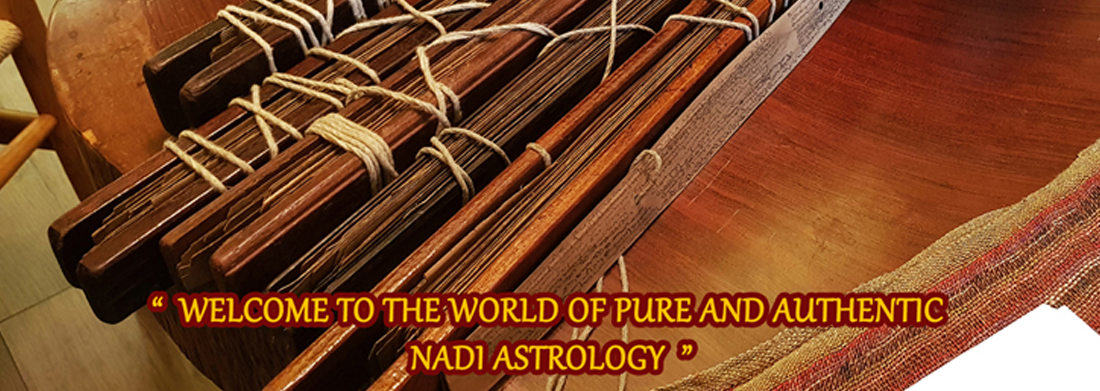
According to tradition, the Nadi palm leaves were written by enlightened sages, known as Rishis or Maharishis, thousands of years ago. These were not ordinary human beings, but souls of immense spiritual power who had transcended time through divine insight (Gnana Drishti).
Among the many Rishis, the most renowned include:
Each sage contributed their divine revelation to guide humanity through karma and liberation (moksha).
The process of writing was not ordinary — it was divinely channeled through meditation and spiritual vision.
Each palm leaf is a divine map of the soul — handwritten, vibrational, and timeless.
The preservation of these palm leaves is as miraculous as their creation. Despite being made of organic material, many have survived over 2,000 years, thanks to meticulous care and sacred maintenance.
The majority of authentic Nadi leaves are preserved in:
Each temple library holds thousands of leaves, organized by sage, thumbprint category, and karmic type.
The preservation process uses traditional Ayurvedic techniques:
Over time, damaged leaves are re-copied by trained custodians, ensuring the script and energy remain intact.
To make the readings possible, the leaves were systematized with precision:
This organization allows Nadi readers to identify a person’s exact leaf through the thumbprint — a process guided by divine will and intuition.
After centuries, the task of preserving and reading these leaves passed into the hands of temple custodians and hereditary families in Tamil Nadu.
These Nadi readers see themselves not as owners, but as guardians of sacred knowledge.
Their duty is to:
Many of these readers belong to lineages that date back hundreds of years, keeping the tradition alive through devotion and discipline.
With time and climate change, preserving palm leaves has become a challenge. However, both the government and private institutions have taken steps to ensure their protection.
Many libraries have begun scanning and digitizing Nadi leaves to safeguard against physical decay.
This process ensures future generations can access the manuscripts even if the originals deteriorate.
Archives are maintained under controlled humidity and temperature conditions to extend the leaves’ life span.
Today, authentic Nadi centers allow seekers to connect online, providing access to readings without the need to handle the delicate originals.
Through both devotion and modern care, these divine writings continue to illuminate countless lives.
For spiritual practitioners, the act of preserving Nadi leaves is a divine service, not just historical maintenance.
It is believed that:
Thus, every time a Nadi leaf is found and read, it’s more than an act of astrology — it’s a spiritual reunion between soul and scripture.
So, who wrote and preserved the Nadi palm leaves?
They were written by divine sages through meditative revelation — and preserved by generations of temple custodians with unwavering devotion.
What began as sacred insight thousands of years ago continues to guide humanity even today, thanks to their dedication.
Every Nadi leaf that reveals your destiny is not just an ancient record — it’s a living testament to divine compassion, written by the Rishis and protected by faith.

Dr.A.Sivasamy,
Sri Agasthiya Mahasiva Sukshma Nadi Jothida Nilayam ,
S/O V.S.Arul Siva Arumugam,
18, Milladi Street, Nagai District,
Railway station Road, Opp Indian Bank,
VaitheeswaranKoil - 609 117,
Tamilnadu, South India,
04364 279463 |
+91 93 62 22 77 79 |
+91 94 89 25 69 05.
sivasamee@hotmail.com | sivasamee@yahoo.com

Beware of fakes & misguiding websites .© 2026 Srisivanadi All Right Reserved.Design & Developed by
 InnovTouch Technologies